

The short answer: Whether a worker is a W-2 employee or a 1099 contractor isn’t something a business gets to decide by preference — the IRS looks at how much control the business has over the work. Classify it wrong, and the business can owe back payroll taxes, face IRS penalties, and even get sued by the worker it misclassified.
For small businesses across Richmond, Chesterfield, and Midlothian, getting this right is one of the cheapest forms of insurance there is. Here’s how the IRS actually decides — and what it costs when a business gets it wrong.
Why misclassification happens
Many small business owners don’t think about the consequences of not following the IRS rules on Employee vs. 1099 Subcontractor. Some small business owners may be tempted to reduce their payroll expenses by misclassifying individuals as Subcontractors when in reality they should be classified as Employees.
How the IRS actually decides
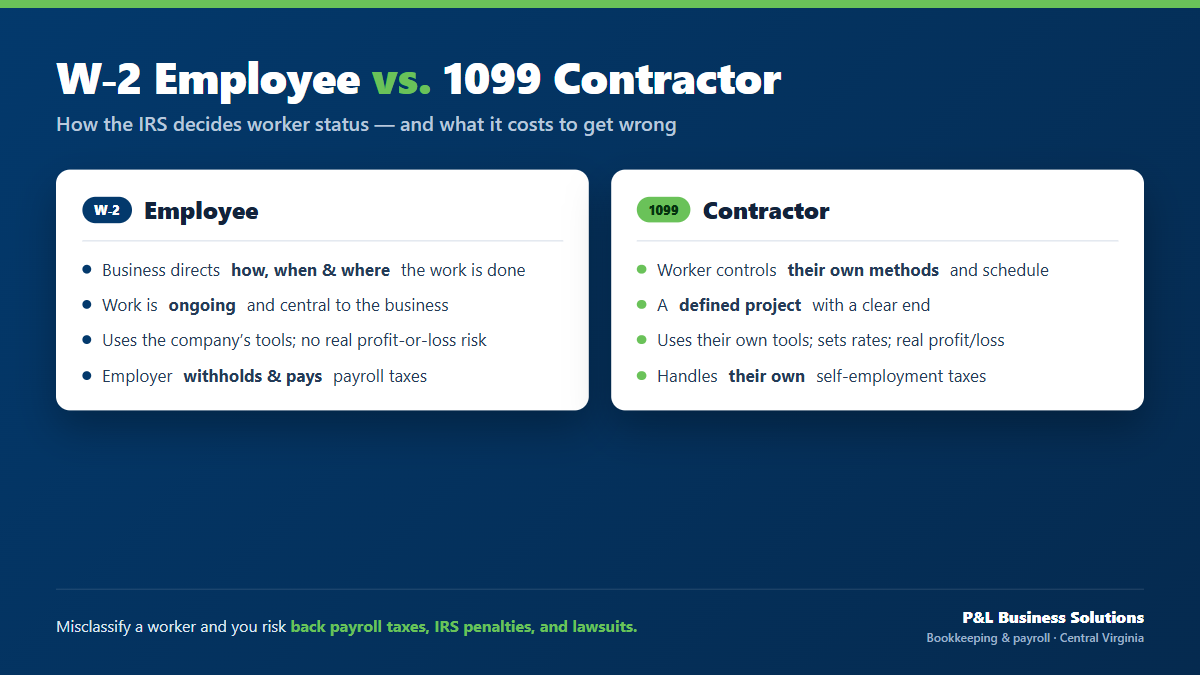
The IRS evaluates three categories of evidence to determine worker status:
- Behavioral control — Does the business direct how, when, and where the work is performed?
- Financial control — Does the worker have a real opportunity for profit or loss, or use their own tools and set their own rates?
- Relationship type — Is the work ongoing and central to the business, or a defined project with a clear end?
No single factor decides it. The IRS weighs the whole relationship, and businesses that guess wrong often don’t find out until an audit, a state unemployment claim, or a worker’s own complaint triggers a review. (The IRS lays out these categories in its own Worker Classification 101 guidance.)
What it actually costs to get wrong
Unfortunately, there are individuals like the owner of North Country Angels, a home health care business in New Hampshire, that take this “cost-saving idea” to an entirely different level. This business owner ended up paying way more than she intended when she recently pleaded guilty to filing a false tax return for under-reporting income. Her process was to take customer payments by check made out to “Cash.” She then paid the Subcontractors with cash, thereby avoiding Medicare and Social Security taxes on the Subcontractors’ payroll wages.
In addition to the payroll liability of incorrectly classifying 1099 Subcontractors that should be Employees, business owners also are exposing themselves to legal risk and individual lawsuits. We know of one local business with several million dollars in annual sales revenue who learned this the hard way. When this business owner fired or stopped using an “independent 1099 Subcontractor” for stealing jobsite-provided materials and tools, the thief turned around and sued the Employer for having them as a Subcontractor instead of a W-2 Employee. The Employer ended up having to pay the thief a hefty settlement since the Employer had avoided this basic IRS rule.
The retirement impact business owners miss
Not only does misclassifying W-2 Employees as Subcontractors go against the law, but it also deprives Subcontractors and even business owners themselves of contributing to the Social Security fund, which for many small business employees and owners ends up being the single largest source of income in retirement. If you don’t pay into the Social Security fund, you don’t get the benefits at retirement. These retirement benefits are based on the ten highest years of earnings during your working career.
Many S Corporation Business Owners use the strategy of taking distributions from their earnings to pay their living expenses and only take a modest W-2 payroll salary. Unless the business owner is over the long-term contributing to an alternative retirement benefit plan that they otherwise would have paid in Social Security taxes, they may find out they are ill-prepared to live on their Social Security benefits at retirement.
Frequently asked questions
What’s the main difference between a W-2 employee and a 1099 contractor? It comes down to control. If the business directs how, when, and where the work happens, the worker is legally an employee, even if both parties agreed to call it a contractor relationship.
Can a 1099 contractor sue if they believe they were misclassified? Yes — this is exactly what happened in the lawsuit example above. A worker can pursue a claim independent of any IRS action.
Does misclassification affect retirement benefits, not just taxes? Yes. Workers paid as 1099 contractors don’t build Social Security earnings history the same way W-2 employees do, which can mean a smaller retirement benefit down the road.
Getting classification right
In the end, your “savings” may end up shutting your business down. It always pays to be on the “up and up” instead of hiding things that will definitely eventually catch up to you.
Call P&L Business Solutions to ensure you are properly identifying W-2 Employees vs. independent 1099 Subcontractors. We help business owners across Richmond, Chesterfield, and Midlothian keep the right accounting processes in place and make sure all payroll taxes are paid and reported correctly. See how our bookkeeping and payroll packages work, or book a time to have your current worker classifications reviewed.
Sources
- U.S. Department of Justice, Office of Public Affairs. “New Hampshire Business Owner Pleads Guilty to Filing a False Tax Return.” justice.gov
- Internal Revenue Service. “Worker Classification 101: employee or independent contractor.” irs.gov